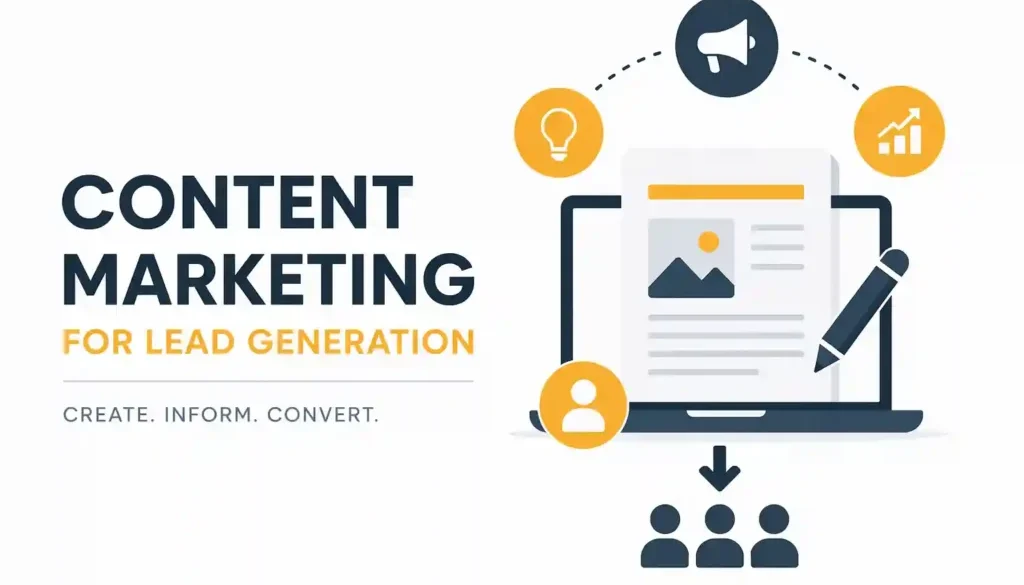
Content Marketing for Lead Generation: 7 Practical Ways to Get Better Results
Content marketing for lead generation is not about posting just to stay active. A lot of businesses create blogs, social media posts, and videos, but those pieces never lead to inquiries or sales. That happens because the content is not built with a clear conversion path.
If you want content to generate leads, it needs to do more than attract attention. It needs to move people from interest to action. That means the content should educate, build trust, and guide the reader toward the next step.
Many businesses focus on volume. They publish more content, but they do not connect that content to their offers. As a result, they get likes, views, or traffic, but very few leads.
That is where content marketing for lead generation becomes valuable. It helps you use content as a system, not just as decoration.
What content marketing for lead generation actually means
Content marketing for lead generation is the process of creating useful content that attracts the right audience and moves them toward a lead action.
That lead action could be:
• filling out a form
• booking a call
• sending a message
• downloading a resource
• requesting a quote
The goal is not just to get people to read. The goal is to get them to respond.
When content is built with that goal in mind, it becomes much more useful to the business.
Why most content does not generate leads
Most content fails because it is disconnected from the business goal.
A blog may explain a topic well, but if it does not point the reader toward a next step, it stays informational. A social post may get engagement, but if it does not support an offer, it does not create business value.
This is one of the biggest problems in content marketing for lead generation. Businesses create content for visibility but not for conversion.
To fix that, content needs structure.
1. Start with the right topic
Every good lead-generating piece starts with the right topic.
The topic should answer a real question your audience already cares about. It should also relate to a problem, need, or decision.
For example, someone searching for help with marketing may want to know how to increase traffic, how to get more leads, or how to build a strategy. That kind of topic gives you a better chance to create useful content that converts.
If the topic is too broad, the content becomes weak. If it is too narrow, it may not attract enough interest.
2. Solve a real problem
People respond to content that helps them.
If your content only sounds polished but does not solve anything, it will not move people forward. Content marketing for lead generation works best when the reader feels understood.
That means your content should:
• explain the problem clearly
• show why it matters
• give a practical solution
• connect the solution to your service or offer
When readers feel that your content solves something real, they are more likely to trust you.
3. Build trust before asking for action
People do not usually convert the moment they see your content.
They need to trust your message first.
That is why useful content matters so much. It shows that you understand the problem and know how to handle it. If your content is consistent and practical, people begin to see you as someone worth listening to.
This is a major part of content marketing for lead generation. Trust makes conversion easier.
4. Include a clear next step
A lot of content stops too early.
It gives value, but it does not tell the reader what to do next.
Every content piece should have a simple next step. That could be:
• read another blog
• contact your team
• download a guide
• book a call
• send a message
Without a clear next step, the content ends as information instead of becoming a lead source.
5. Use content across different channels
Content marketing for lead generation works better when it is used in more than one place.
A blog can be turned into:
• social media posts
• email content
• video scripts
• carousel posts
• short tips for LinkedIn or Instagram
This helps you get more value from one idea. It also keeps your message consistent across channels.
The more places people see your content, the more familiar your brand becomes.
6. Support content with SEO
If people cannot find your content, it will not generate leads.
That is why SEO matters. A well-optimised blog can bring in people who are already searching for the exact problem you solve.
When content marketing for lead generation is supported by SEO, the content has a much better chance of bringing in the right visitors.
That means using:
• the right keyword
• proper headings
• internal links
• strong titles
• useful meta descriptions
SEO helps the right people find your content. Conversion helps turn them into leads.
7. Track what content brings results
Not every blog or post will perform the same way.
Some topics bring traffic. Some bring leads. Some do both.
That is why you need to track performance. Look at:
• which pages get the most visits
• which pages lead to inquiries
• Which topics bring high-intent visitors
This helps you focus more on content that actually supports your business goals.
Content marketing for lead generation becomes much stronger when you improve based on data instead of assumptions.
Final thoughts
Content marketing for lead generation works when content is tied to a clear purpose. It should attract the right people, build trust, and guide them toward action.
If your content only informs, it may get views. If it is built properly, it can generate leads.
That is the difference between content that looks useful and content that actually grows a business.
A strong content system does not just fill space. It supports the funnel, strengthens the brand, and helps turn atten
tion into opportunities.
Building a strong content system requires more than posting regularly. It needs structure, clarity, and consistency. That is the approach I follow in my digital marketing work. Learn more
FAQ
What is content marketing for lead generation?
It is the use of useful content to attract the right audience and turn them into leads.
Why is content important for lead generation?
Because it builds trust, answers questions, and guides people toward action.
How do I make content generate leads?
By solving real problems, adding clear next steps, and connecting content to your offer.