Sales Funnel for Small Businesses: 7 Simple Steps That Work
A sales funnel for small businesses is what turns attention into action. Many businesses spend time trying to get traffic, but they never build a proper path that moves people from interest to inquiry to purchase. That is why marketing often feels inconsistent.
You can post content, run ads, and get website visitors, but if there is no funnel behind it, most of that attention disappears.
A sales funnel for small businesses gives structure to the customer journey. It helps people understand your offer, trust your business, and take the next step without confusion. That is what makes it one of the most important parts of digital marketing.
What a sales funnel for small businesses actually does
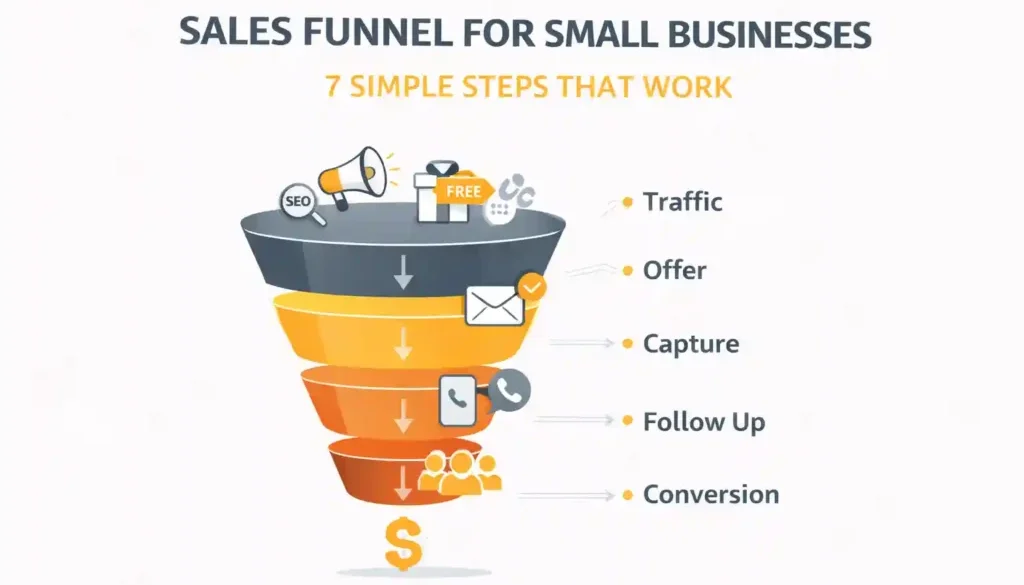
A sales funnel for small businesses is a step-by-step process that guides a potential customer from awareness to conversion.
It usually includes:
• Traffic source
• Landing page
• Offer
• Lead capture
• Follow-up
• Conversion
Without this structure, leads slip away. People may visit your website, but they will not always know what to do next. A funnel removes that uncertainty.
Why small businesses need a funnel
Most small businesses do not lose customers because their service is bad. They lose them because the journey is unclear.
A person may see your ad, visit your site, and still leave without contacting you. That happens when there is no clear offer or next step.
A sales funnel for small businesses solves that problem by creating a path. It tells the visitor what to do and gives them a reason to continue.
That makes your marketing more predictable.
1. Start with the right traffic
Every funnel begins with attention.
You need the right people entering your system. This can come from:
• SEO
• Google Ads
• Social media
• Content marketing
• Referrals
Not all traffic is equal. A sales funnel for small businesses works best when the audience already has some interest in your offer.
If the traffic is irrelevant, the funnel will struggle no matter how good the rest of the system is.
2. Create a clear offer
The offer is the reason someone should continue.
If your offer is vague, people will not take the next step. Your offer should be simple, useful, and easy to understand.
Examples include:
• Free consultation
• Free audit
• Quote request
• Discovery call
• Limited-time service package
A strong offer improves the chances of converting visitors into leads.
3. Use a focused landing page
A landing page is where the funnel starts working.
A sales funnel for small businesses needs a landing page that does one job well. It should not try to explain everything. It should guide the visitor toward one action.
A good landing page includes:
• A clear headline
• One main offer
• Benefits
• Trust signals
• A visible call to action
If the page is cluttered or confusing, the funnel breaks.
4. Capture the lead properly
Once a visitor is interested, you need a simple way to capture their details.
This could be a form, phone call, message, or email signup.
The key is to make the process easy. Long forms and too many steps reduce conversions. A sales funnel for small businesses should reduce friction, not add more of it.
The easier it is to respond, the more leads you will get.
5. Follow up quickly
Most leads do not buy right away.
That does not mean they are lost. It means they need follow-up.
Follow-up can include:
• Email sequence
• WhatsApp message
• Retargeting ads
• Manual call back
This is one of the most ignored parts of a funnel. A sales funnel for small businesses becomes much more effective when the follow-up is fast and consistent.
6. Build trust over time
People rarely convert just because they saw one page.
They need reminders. They need proof. They need confidence.
That is where content, testimonials, reviews, and social proof help.
A good funnel uses trust to move people forward. If your business feels credible, people are more likely to convert.
7. Track and improve everything
A funnel is not something you set once and forget.
You need to track:
• Traffic source
• Conversion rate
• Cost per lead
• Lead quality
• Drop off points
This helps you understand what is working and what is not.
A sales funnel for small businesses improves over time when you keep testing and refining it.
Final thoughts
A sales funnel for small businesses is not complicated, but it is essential.
It helps you turn traffic into leads, leads into conversations, and conversations into customers. Without it, marketing stays random. With it, marketing becomes structured and predictable.
If you want your business to grow online, stop thinking only about getting more traffic. Start thinking about the path that turns that traffic into revenue.
That is where real growth happens. Learn more.
FAQ
What is a sales funnel for small businesses?
It is a step-by-step system that guides visitors from awareness to conversion.
Why is a sales funnel important?
It helps turn traffic into leads and makes marketing more predictable.
What does a sales funnel include?
Traffic, landing page, offer, lead capture, follow-up, and conversion.